This Would Actually Make America Great Again Sarah Schuar
Daryl Davis, a blackness musician who has made a exercise of befriending members of the Ku Klux Klan, says he knows exactly what racists hear in the slogan "Make America Dandy Over again."
Donald Trump "won the election on one word, one discussion only. And that word was 'again,' " Davis says.
"When was 'over again?' " Davis asked during an interview at his dwelling in May, discussing race relations in the age of President Trump. "Was information technology dorsum when I was drinking from a divide h2o fountain? Was it when I couldn't eat in that restaurant over in that location? ... Make America Great Over again -- before I had equality?"
Trump told The Washington Post he idea of the slogan in 2012 and trademarked it immediately, although similar words have been used past politicians as far back as President Ronald Reagan.
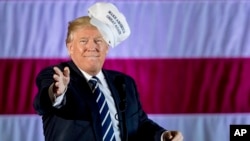
President Beak Clinton is on tape as having used it during his presidential entrada in 1991, although non as an official slogan. Nevertheless, in 2008, while candidature for his wife, he noted: "If you're a white Southerner, yous know exactly what information technology means, don't you?"
Is it possible that Trump was elected to the presidency with a racially charged slogan? Or are supporters and critics simply hearing what they want to hear?
Christian Picciolini, a quondam neo-Nazi who now works to help other white supremacists go out the motion, says the slogan fits into the alt-right's efforts to make its bulletin more bonny by toning down the rhetoric.
"That was a concerted effort," Picciolini says in an advisory video for Vox news. "We knew we were turning more people away that nosotros could eventually take on our side if we but softened the bulletin. These days with our political climate we see a lot of coded language, or canis familiaris whistles." (Picciolini'due south use of "canis familiaris whistle" refers to a subtle message meant to be understood only by a detail grouping of people, like a whistle pitched high plenty that a dog might hear it, just a human would non.)
"Make America Not bad Again?" Picciolini asks rhetorically. "Well, to them, that means make America white over again."
In June 2016, a Tennessee politician even put that on a billboard. Rick Tyler, running for a congressional seat in mostly white Polk County, Tennessee, explained that his "Make America White Once more" billboard was meant to evoke the mood of 1950s America, when television shows idealized the image of the happy white family.
In a Facebook post, Tyler said, "Information technology was an America where doors were left unlocked, violent crime was a mere fraction of today's rate of occurrence, there were no machine jackings, home invasions, Islamic Mosques or radical Jihadist sleeper cells."
Tyler's billboard quickly drew negative national attention and was taken down within a few days.

Better economical times
President Trump says he only meant the slogan to refer to better economic times.
"I felt that jobs were pain," Trump told the Post in January. "I looked at the many types of disease our country had, and whether it'due south at the border, whether it'due south security, whether it'due south police and order or lack of law and gild."
Trump said the slogan "inspired me, because to me, information technology meant jobs. It meant industry. And it meant armed services strength. It meant taking care of our veterans. It meant so much."
David Axelrod, chief political strategist for former president Barack Obama, credits Trump with understanding his audition and crafting a bulletin whose flexibility was part of its entreatment.
Trump, Axelrod told the Post, "understood the market that he was trying to reach. Y'all can't deny him that." He added, "In terms of galvanizing the market that he was talking to, he did information technology single-mindedly and ingeniously."
And then who is Trump's market? Co-ordinate to surveys, at its cadre are white men in the blue-collar sector -- the demographic with the virtually to lose when women and minorities started gaining more rights and earning power over the past few decades. Merely people who find promise in "Make America Great Again" come from more than merely that narrow category.
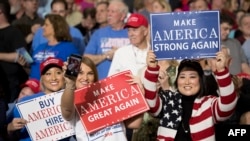
Jason Rankin, a real estate amanuensis in Knoxville, Tennessee, described his thoughts nigh the slogan this way: "Making America Bully Once again to me means at least the following things: less national debt, more secure borders, more freedom of speech, more gun rights, more chore opportunities across the country (but especially in rural areas), higher GDP, stronger national security & a stronger military, more than money in every American's banking concern account."
Tony Goicochea, an sound engineer in Washington, D.C., said Make America Great Again "has a vision to it," as well as a reference that, to him, speaks of greater economic prosperity in the past, and financial lives unburdened past crippling debt.
Growing up in the 1980s, Goicochea said, "I saw people go to college, they graduated, and they got a task. That was it. They were able to move out on their own and start a life for themselves. So I think about our economics, how much meliorate our economics were."
At present, Goicochea noted, American families are experiencing a boomerang syndrome -- recent graduates who have moved dorsum in with their parents considering they cannot make plenty money to support themselves and pay off college debt.
Shannon Crannick, a retail consultant in Festus, Missouri, says she believes making America great again means "putting an stop to all the hate that has come up effectually in the last few years. Making it safe to walk down the street again. Less debt, secure borders, more support for the military, freedom of speech coming back, meliorate assistance for the poor and people loving each other once again."
Amend for whom?
In a Washington Post/ABC News poll taken in September 2016, three-quarters of self-identified Trump supporters said America's greatest days are in the past.
When the aforementioned question was asked of other demographic groups, withal, five out of six African-Americans disagreed.
The polltakers concluded that one'due south estimation of the country's greatness depends on factors such as gender, race and didactics level -- the kinds of factors that have a straight affect on income and political representation.
Hence, "Make America Keen Again," doesn't but entreatment to people who hear it equally racist coded language, but besides those who have felt a loss of status equally other groups have become more empowered.
Marketing consultant Eva Van Brunt, a critic of the president, says the malleability of the words "cracking" and "again" are a common marketing flim-flam: using words that audio positive, only lack specific meaning.
"Past leaving a definitional vacuum effectually the word 'great,' information technology became very like shooting fish in a barrel for groups to co-opt information technology, ascribing to it the meaning they wanted information technology to accept," Van Burden says. "The same way a mother rests easy considering her baby's food has 'all-natural' written on the jar, Nazis, the KKK, and other white supremacists were able to experience good nigh Trump because 'great' became interchangeable with white, heterosexual, male, detest, oppress, deport.
As for the word "again," VanBrunt notes that it limits the audience to those who think America was once cracking and no longer is.
"That excludes those who never idea America was peachy for them and those who think America is great for them now," she says. "Looked at from that vantage point, it'south hard to imagine that the co-opting past certain groups was accidental."
Different interpretations
For better or worse, the phrase is a loaded 1, with potential to cause problem betwixt people who practise not share the aforementioned interpretation.
On August xix at Howard University in Washington, D.C., two white teenage girls on a summer enrichment trip entered a campus cafeteria while wearing "Make America Great Again" trucker hats that they had recently bought at a suburban mall.
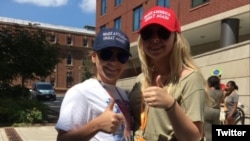
The girls, part of a group of students from Union Urban center High School in Pennsylvania, say they were unaware Howard was an historically black university.
"I don't even recollect our advisers really knew," 16-year-old Allie Vandee, 1 of the hat-wearers, told Buzzfeed. "We just thought of Howard University, we know it's historic, and then we kinda went," she said.
Howard University students who witnessed the event say students chastised the teenage visitors for wearing the slogan. One walked up and snatched at their hats. Another ane cursed at them. The teenage girls left the cafeteria and shared their experience on Twitter. They say they were unfairly harassed.
The incident prompted discussions online and on campus at Howard. It has resulted in no major protests, turf wars or Twitter feuds. Simply information technology was an indicator of securely dissimilar interpretations of that item four-word phrase.
Student Merdie Nzanga, a junior at Howard, was in the cafeteria when the teenagers walked in. She said several of her friends confronted the teenagers for being insensitive.
"I didn't say annihilation," she told Buzzfeed. Simply, "to myself, I idea, 'This is going to be trouble.'"
Source: https://www.voanews.com/a/is-make-america-great-racist/4009714.html
0 Response to "This Would Actually Make America Great Again Sarah Schuar"
Post a Comment